Every year, as board results are announced, schools celebrate percentages, ranks, and toppers. Headlines are written, expectations are reinforced, and success is neatly reduced to numbers. But in the middle of this celebration, an important question quietly disappears — what do these marks actually tell us about a student?
The beginning of a new academic year brings energy and optimism. For some, it is a continuation; for others, a chance to start over. Yet it also carries the lingering weight of results: of what was achieved and what fell short. Academic excellence deserves recognition; it reflects discipline, effort, and perseverance. But if we pause for a moment, we must ask: is that all education is meant to measure?
In how we introduce ourselves — our qualifications, institutions, and achievements — we often reduce identity to measurable markers. What gets left out is harder to quantify: our values, our awareness, our humanity. Numbers make comparison easy, but they also make understanding shallow.
Education, historically, has never been merely a tool for individual advancement. It has been a means for societies to grow and evolve. Institutions such as Nalanda and Taxila were not just centres of vocational learning; they were spaces where knowledge shaped thought, character, and perspective. Education was not confined to what one could do — it extended to how one understood and engaged with the world.
To be educated is, first and foremost, to be curious. A degree is not a finish line but a milestone — it marks progress, not completion. An educated mind asks questions: about its surroundings, its society, and the ideas it encounters. It resists passive acceptance and seeks deeper understanding.
Curiosity, however, cannot exist in isolation. It must be accompanied by empathy. A truly educated individual does not merely accumulate knowledge but develops the capacity to understand others — their circumstances, their struggles, and their perspectives.
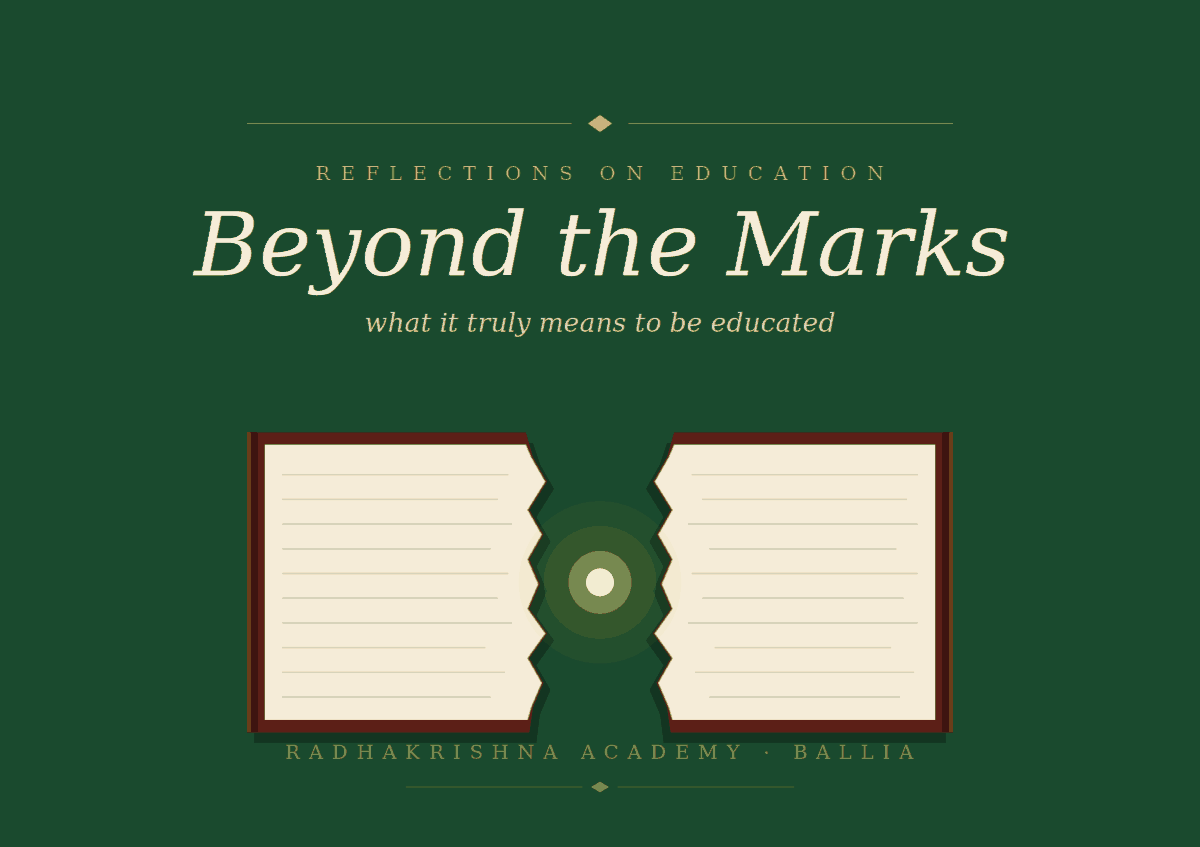
I recall a moment from the classroom that captures this better than any definition. During an examination period, a student who often struggled academically realised that a classmate had lost his textbook. Without hesitation, he tore his own book into two halves so that they could both study, one using each half at a time. By conventional academic standards, he may not have been among the "top performers." But in that moment, he demonstrated a depth of understanding and humanity that no examination could measure.
Equally essential is awareness. To be educated is to be conscious of the world one inhabits: socially, culturally, and politically. It involves the ability to recognise injustice, not only in its most visible forms but also in the subtle, everyday inequalities that often go unnoticed. In a democracy, education is not just personal enrichment; it is preparation for responsible citizenship.
Such awareness requires intellectual honesty. Too often, education — especially in the social sciences — is framed in terms of celebration or blame. But its true purpose lies in understanding. History, for instance, is not meant to be a source of pride or shame alone; it is a record of human experience from which we learn. An educated individual engages with the past thoughtfully, without defensiveness, and applies those lessons to the present.
In an age increasingly defined by the technocratisation of education, where outcomes are measured, ranked, and optimised, its deeper purpose risks being overshadowed. Education is not simply a collection of certificates or a record of achievement; it is a lifelong process of becoming more thoughtful, aware, and humane.
As John Lennon once suggested, schools often focus on what we should become, while overlooking what truly matters. Perhaps the real success of education lies not in producing perfect scores, but in shaping individuals who can think critically, act empathetically, and engage responsibly with the world around them.
If students leave school not just informed, but aware; not just skilled, but thoughtful, then education has done its job — regardless of the marks they carry with them.